Sometimes a Good Notion

Favorite Shorts: The Man Who Never Cried. Dir. Bradley Jackson
Showing this one today in Screenwriting 2. I find it to be well crafted and acted. Particularly good use of sequences that get us through large chunks of narrative time.
Most students, particularly when they are starting, try to be so ambitious in their storytelling. They want to write feature stories in 15 pages and are typically surprised when it doesn’t work out so well. The best shorts are simple… simple concepts, actions, and through lines. This is one of those.
Script of the Week: The Imitation Game by Graham Moore
Moore’s script was selected to the top of the Blacklist last year. The logline they used was the following: “The story of British WWII cryptographer Alan Turing, who cracked the German Enigma code and later poisoned himself after being criminally prosecuted for being a homosexual..” It immediately caught my attention and I have been in search of this script for the better part of a year. When I finally got my hands on it last week I delved right in and was completely delighted by it.
Moore does far more than to biographize Alan Turing. The Imitation Game reads more like an Espionage Thriller than a Bio-Pic. In this aspect the story is mediocre, trudging along from plot point to plot point and solving the central mystery of the film through sheer coincidence rather than the prowess of the main character. Where Moore succeeds, excels in fact, is in the creation of Turing himself.
The Turing we get is whip smart, socially inept, unintentionally hysterical, and a complete bastard. Turing doesn’t care what people think of him. His pursuit is solely focused on the few things that challenge him in this world. The mysteries thought impossible to solve. The enigmas. In this pursuit he is a bulldozer swinging and thrashing, destroying everything in his path including every relationship he’s had and the possibility of ever being happy.
The script follows three distinct timelines and does so effortlessly. The primary timeline is about the solving of Enigma but it is in the sub-plots that the most interesting aspects of this script reside. Moore cuts back and forth from the present where Turing is being investigated by police for being a homosexual to Turing’s childhood where he meets Christopher Morcom, his first love. These two narratives inform the solving of Enigma and fill Turing’s behavior with intelligent if not subtle subtext.
Moore creates a Turing who is concerned with understanding his own difference. We see him try to adapt and imitate. To explain it logically. Turing tries to play the game as we all do but fails miserably because of his own ego. Moore, very adeptly, never lets us forget that Turing is not a hero despite saving millions of lives. He is a tragic figure hell bent on self destruction.
Alone With Leni
I’m not teaching History of Film this term. When this happens I get a rare opportunity to reexamine my lectures and class plans. I find it much easier to be objective about my work when I’m not neck deep in the pressure of having 3 hours of lecture prepared each week.
 I stop myself on a lecture I do on Leni Riefenstahl which, even when I give it, feels incomplete. As if there is something that I want to say about her but can’t. The lecture itself is well designed. It consists of about 40 minutes of Riefenstahl history including up to the beginning of her work for the Nazi Party. Then about 1 hour of footage from Triumph of the Will accompanied with my commentary on shot composition and technique. Then 15 minutes of her Post Nazi history accompanied by 20 minutes of the terrific documentary The Wonderful Horrible Life of Leni Riefenstahl. This leads the students to a sometimes heated discussion about art and responsibility, which is exactly where I want them to be by the end of the class. The lecture works as intended and the student is forced to think.
Controversy is not the problem. I do full days on Griffith and Kazan. I want my students to think about how they as filmmakers are communicating and the reasons they are communicating. It’s not the controversy that makes the lecture seem unfinished and messy. It’s that Riefenstahl feels alone. Outside of the narratives that other filmmakers fit into. She doesn’t belong to a movement or school that can be easily surmised in bullet points. Her story is unique, and perhaps I’m not helped by introducing her “as the only female director we will be discussing.”
And so I sit here, reading my lecture, wondering if Riefenstahl can be put into any context other than the Nazi story I’m used to telling. Is hers the story of female directors? Alongside what filmmakers can she be placed? Or is Riefenstahl’s narrative so unique, so strange, so self made, that she is forever relegated to being studied alone?
Script of the Week: Stoker by Wentworth Miller
I’ve read Stoker twice this year. The first time I was on a plane to Italy.I didn’t know what to make of it. I couldn’t figure out the appeal. To be fair, I did have a few glasses of wine during the reading, which in addition to the jet-lag, might have contributed to my overall state of confusion regarding this script and life in general. However, the script’s weirdness stuck with me and I vowed to read it again.
I did so recently and found a beautifully told coming of age story. One filled with violence and murder. One akin to Stand by Me or other dark visions of lost innocence. Mr. Wentworth is concerned with the experience of maturing as one with tough and almost impossible choices that cannot be put off . The coming of age is the coming of self, and the self we choose to become in that moment (our adolescence) is the self we will be for the rest of our lives. It’s a bit of a depressing vision of growing up but it effectively keeps the stakes high and feeds the script enough tension to keep it interesting.
Stoker tells the tale of Indira Stoker, a strange and solitary girl dealing with the death of her father. Complicating matters are her apathetic and fabulous lush of a mother and an uncle whose visit comes as a surprise to all of them. Charlie, her uncle, brings with him an arsenal of violent intentions and transformative family secrets. No one in his wake will ever be the same.
From the first page Mr. Miller demonstrates that he can do much more than break out of prison (couldn’t help myself). He opens on the image of a spider living inside a piano who is disturbed by the pounding of the keys. The spider makes it’s way out of the piano to explore the source of the intrusion only to meet its squishy, gooey, and violent demise under the foot of Indira Stoker. It is a very telling moment when she, “with no more than a glance”, fails to consider the violence of her action or the death she has just caused. Will she approach her life that way? Is that who she will be? These are the question Mr. Miller poses of his character and he is relentless in pushing her to discover the answers.
It’s a phenomenal piece of writing, really… It’s enhanced by beautiful prose rare in a screenplay and a hell of a lot of personality which Mr. Miller successfully incorporates. The result is a brooding meditation on growing up and I am sure that in the hands of a director like Chan-Wook Park it’s going to make for a very interesting watch.
Starting Over 3 Times A Year
I love the start of a new term. The campus buzzes with life and the days are light. There’s no work yet, just a list of new names I have to memorize.
On The Third Day Of Grading My Students Gave To Me:
Discovery: There is nothing more thrilling than a student who discovers something new and exciting about their story while they are writing it. I’ve had such a case this term with a student who found a theme on which he could build subtext that was not present at the time they started to write. They came onto to it, recognized it, and over used it as it happens with most writers. However, I give the student props for aspiring to make their story interesting.
Repetition: It is as if they forget what they just wrote or perhaps they think it’s so good that they need to write it over and over again. Repetition makes a script slow and bogged down with unnecessary words.
No Christmas gifts yet from them.
McKee Says
I open up Robert McKee’s Story to a random page and write about what he says.
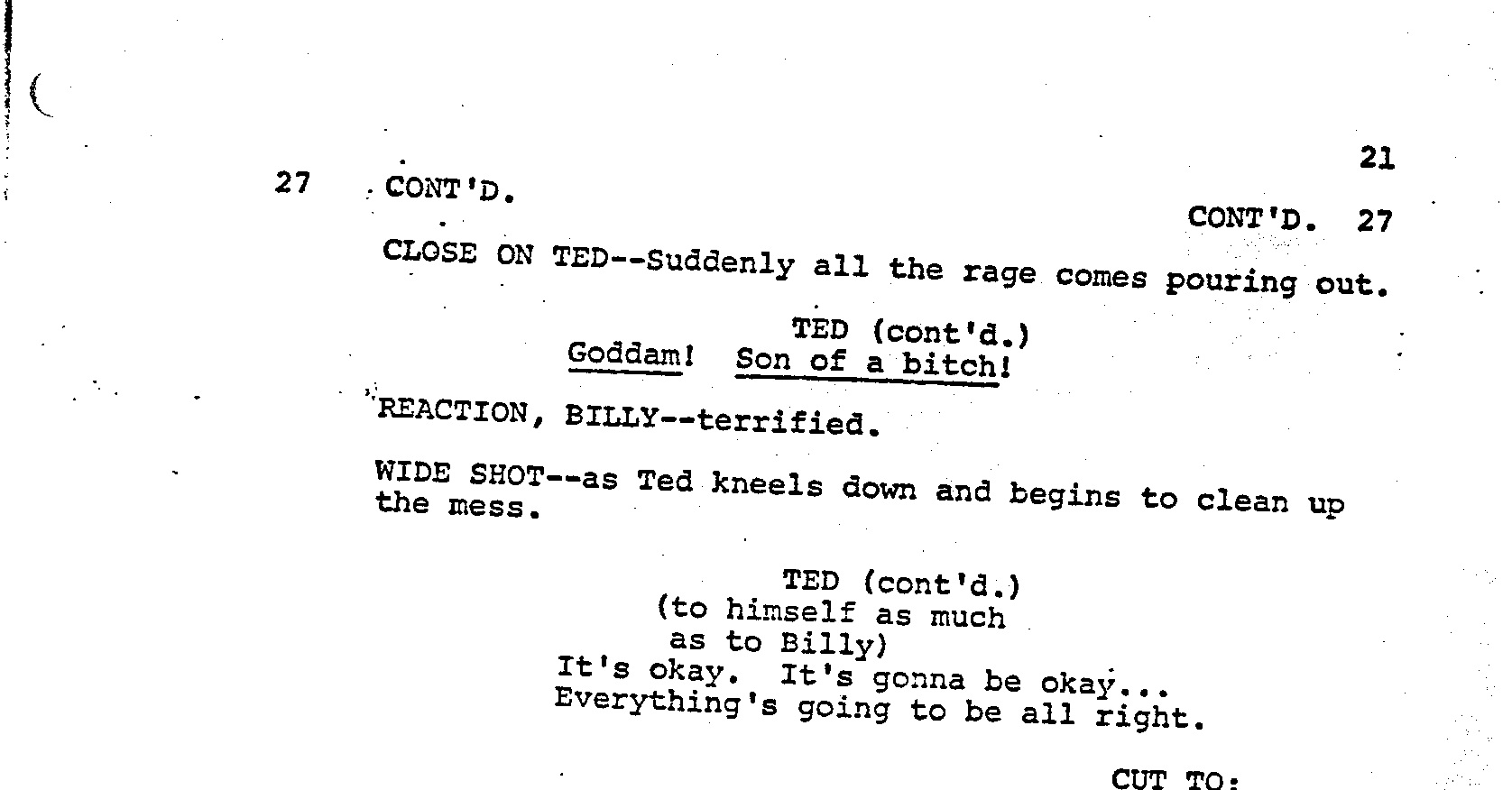
To achieve complexity the writer brings characters into conflict on all three levels of life, often simultaneously. For example. The deceptively simple but complex writing of one of the most memorable events in any film for the last two decades: the French Toast scene from Kramer vs. Kramer . This famous scene turns on a complex of three values: self-confidence, a child’s trust and esteem for his father, and domestic survival. As the scene begins all three are at the positive charge.
The three levels of conflict that Mckee is referring to are inner, personal, and extra-personal . And he is absolutely right, the scene has all three. On the extra personal level Kramer finds himself in conflict with the kitchen which is foreign to him. The personal is the son, who he has to lie to, promise to, and feed. The inner is the insecurity about his own ability to get through this moment and the rest of their lives. It all bubbles to the surface and the simple act of making French Toast is transformed into a moment filled with meaning and tension that rises and explodes.
Developing moments like this is what every writer dreams off and it’s not easy. It cannot be forced. It requires an understanding of why the scene is being written in the first place and then the complex layers of character and symbolism can come into play.
It is also an example of brilliant acting and an actor who knows he is the instrument through which subtext is delivered. Hoffman adds two little words (Goddamn her!) at the end of the scene. These words change the nature of that moment and get right down to what the scene is about. They express the reason we are in that kitchen in the first place: Kramer needs to realize that he cannot take his wife’s departure for granted, there is simply too much at stake.
What It All Comes Down To
Every term ends the same way. A pile of scripts and script pages on my desk to read through and comment on. It will grow smaller every day like a bar of soap or a lipstick.

Do Something For Your Art Everyday
A lifetime ago I lived in NY and worked for Susan Batson at the Black Nexxus Studios. It was an incredibly dynamic place. I remember that on a cork board somewhere in the office there was a little piece of paper tacked on that said “Do Something For Your Art Every Day.” I don’t know if Susan came up with it or if she got it from somebody else, but seeing that little message daily made it stay with me.
I think about it now because in talking with my students during the last day of class I found myself repeating those words to them. I have a student who has incredible work ethic; he’s producing a web series, putting out an episode a week. It’s an astonishing amount of work, but procrastination limits the quality of the work. So I told him about Susan, about the little refrain on the cork board, and that finding, perhaps 1 hour of the day that he dedicates to just working on honing his craft would make a world of difference in his work and in his life. As soon as I said it I thought about this blog and how I hadn’t posted in almost a week. I thought about how easy it is to become busy and how brilliant it was for that little refrain to be tacked on to a cork board where everyone could see it multiple times a day. You couldn’t forget to do something for your art because there it was to remind you. The brilliance of which I’m sure was not accidental considering its source.
So I’ve typed it up, cut it up, and taped it right onto my computer so I never forget that doing something for my art every day is exactly why I started Sometimes a Good Notion.
 Sometimes a Good Notion