Sometimes a Good Notion

Archive for the month “December, 2011”

On The Third Day Of Grading My Students Gave To Me:

Discovery:   There is nothing more thrilling than a student who discovers something new and exciting about their story while they are writing it.  I’ve had such a case this term with a student who found a theme on which he could build subtext that was not present at the time they started to write.   They came onto to it, recognized it, and over used it as it happens with most writers.  However, I give the student props for aspiring to make their story interesting.

Repetition:  It is as if they forget what they just wrote or perhaps they think it’s so good that they need to write it over and over again.  Repetition makes a script slow and bogged down with unnecessary words.

No Christmas gifts yet from them.

McKee Says

I open up Robert McKee’s Story to a random page and write about what he says.

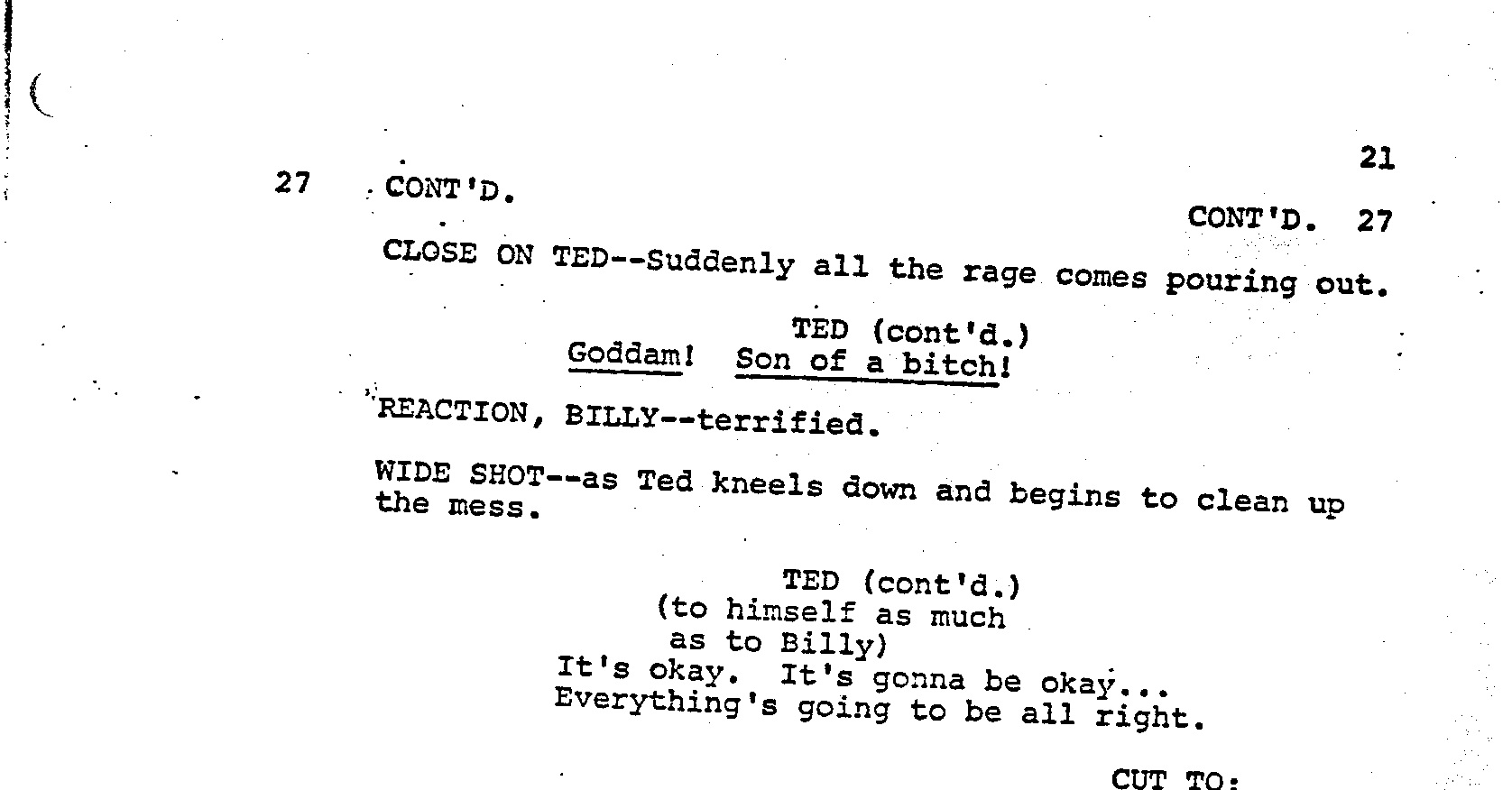
To achieve complexity the writer brings characters into conflict on all three levels of life, often simultaneously.  For example. The deceptively simple but complex writing of one of the most memorable events in any film for the last two decades: the French Toast scene from Kramer vs. Kramer . This famous scene turns on a complex of three values: self-confidence, a child’s trust and esteem for his father, and domestic survival. As the scene begins all three are at the positive charge.

The three levels  of conflict that Mckee is referring to are inner, personal, and extra-personal .  And he is absolutely right, the scene has all three.  On the extra personal level Kramer finds himself in conflict with the kitchen which is foreign to him.  The personal is the son, who he has to lie to, promise to, and feed.  The inner is the insecurity about his own ability to get through this moment and the rest of their lives.  It all bubbles to the surface and the simple act of making French Toast is transformed into a moment filled with meaning and tension that rises and explodes.

Developing moments like this is what every writer dreams off and it’s not easy. It cannot be forced. It requires an understanding of why the scene is being written in the first place and then the complex layers of character and symbolism can come into play.

It is also an example of brilliant acting and an actor who knows he is the instrument through which subtext is delivered.  Hoffman adds two little words (Goddamn her!) at the end of the scene. These words change the nature of that moment and get right down to what the scene is about. They express the reason we are in that kitchen in the first place:  Kramer needs to realize that he cannot take his wife’s departure for granted,  there is simply too much at stake.


What It All Comes Down To

Every term ends the same way. A pile of scripts and script pages on my desk to read through and comment on.  It will grow smaller every day like a bar of soap or a lipstick.

Do Something For Your Art Everyday

A lifetime ago I lived in NY and worked for Susan Batson at the Black Nexxus Studios.  It was an incredibly dynamic place.  I remember that on a cork board somewhere in the office there was a little piece of paper tacked on that said “Do Something For Your Art Every Day.”  I don’t know if Susan came up with it or if she got it from somebody else, but seeing that little message daily made it stay with me.

I think about it now because in talking with my students during the last day of class I found myself repeating those words to them.  I have a student who has incredible work ethic; he’s producing a web series, putting out an episode a week. It’s an astonishing amount of work, but procrastination limits the quality of the work. So I told him about Susan, about the little refrain on the cork board, and that finding, perhaps 1 hour of the day that he dedicates to just working on honing his craft would make a world of difference in his work and in his life.  As soon as I said it I thought about this blog and how I hadn’t posted in almost a week.  I thought about how easy it is to become busy and how brilliant it was for that little refrain to be tacked on to a cork board where everyone could see it multiple times a day.  You couldn’t forget to do something for your art because there it was to remind you. The brilliance of which I’m sure was not accidental considering its source.

So I’ve typed it up, cut it up, and taped it right onto my computer so I never forget that doing something for my art every day is exactly why I started Sometimes a Good Notion.

Here Come The Tributes

The following is a speech given by Streep at a tribute for Vanessa Redgrave.

It’s one of those moments that are typical of this season when fabulously talented people gush about fabulously talented people and it’s ridiculous and lovely. Streep doesn’t seem to have an arrogant bone in her body and what’s wonderful about this speech is that she doesn’t seem to understand that the way she feels about Redgrave is the way that people feel about her.

Redgrave is bound to be on people’s lips this season, early reviews of Coriolanus are in and she is supposedly tremendous in it. Volumnia is a great role. As for me, I don’t make claims to know a lot about Redgrave. I’ve of course seen Julia but remember her more for smaller roles in movies like Deep Impact and Murder on the Orient Express. However, Redgrave is the only actor that I have ever had in mind when writing a character. She made an impact on me but pointing out the moment she came into my mind and stayed there is currently difficult if not impossible.

TILDA

The National Board of Review threw the horse race into motion with its winners this week. Tilda made the cut — it’s an interesting alternative to Meryl Streep,Viola Davis, Michelle Williams, & Glenn Close who probably have the strongest campaigns. All I have to say is that — Tilda is amazing.

I’m Also very happy about Christopher Plummer’s best supporting actor. The man has been making pictures since 1953 and never won an Oscar, Golden Globe, or SAG award. This needs to be a sweep all the way to the end. (An Alan Rickman recognition in this category would also be equally satisfying.)

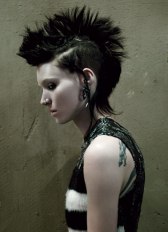
Rooney Mara making waves and Pariah, which I have yet to see but which stars the fab Adepero Oduye who I knew back in NY, also got a mention.

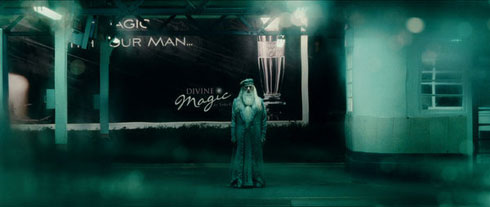
Last but not least, Harry Potter getting 2 mentions is great, it keeps the most successful movie franchise in the race for gold. Over 6 billion dollars in 8 films, easily topping Star Wars and James Bond with the added bonus that it got the world to read.

Best Actor
George Clooney, The Descendants

Best Actress
Tilda Swinton, We Need to Talk About Kevin

Best Adapted Screenplay
Alexander Payne and Nat Faxon & Jim Rash, The Descendants

Best Animated Feature
Rango

Best Director
Martin Scorsese, Hugo

Best Documentary
Paradise Lost 3: Purgatory

Best Ensemble
The Help

Best Film
Hugo

Best Foreign Language Film
A Separation

Best Original Screenplay
Will Reiser, 50/50

Best Supporting Actor
Christopher Plummer, Beginners

Best Supporting Actress
Shailene Woodley, The Descendants

Breakthrough Performance
Felicity Jones, Like Crazy

Breakthrough Performance
Rooney Mara, The Girl with the Dragon Tattoo
Debut Director
J.C. Chandor, Margin Call

NBR Freedom of Expression
Crime After Crime

NBR Freedom of Expression
Pariah

Special Achievement in Filmmaking
The Harry Potter Franchise – A Distinguished Translation from Book to Film
Spotlight Award
Michael Fassbender (A Dangerous Method, Jane Eyre, Shame, X-Men: First Class)

Top 10 Independent Films
(in alphabetical order) 50/50, Another Earth, Beginners, A Better Life, Cedar Rapids, Margin Call, Shame, Take Shelter, We Need To Talk About Kevin, Win Win

Top 5 Documentaries
(in alphabetical order) Born to be Wild, Buck, George Harrison: Living in the Material World, Project Nim, Senna

Top 5 Foreign Language Films
(in alphabetical order) 13 Assassins, Elite Squad: The Enemy Within, Footnote, Le Havre, Point Blank

Top Films
(in alphabetical order) The Artist, The Descendants, Drive, The Girl with the Dragon Tattoo, Harry Potter and the Deathly Hallows Part 2, The Ides of March, J. Edgar, The Tree of Life, War Horse

Marry The Night

            GAGA
When I look back on my life, it’s
not that I don’t want to see things
exactly as they happened, it’s just
that I prefer to remember them in
an artistic way. And - truthfully -
the lie of it all is much more
honest because I invented it.
Clinical psychology tells us,
arguably, that trauma is the
ultimate killer. Memories are not
recycled like atoms and particles
in quantum psychics - they can be
lost forever. It’s sort of like my
past is an unfinished painting, and
as the artist of that painting I
must fill in all the ugly holes and
make it beautiful again. It’s not
that I’ve been dishonest, it’s just
that I loathe reality. For
example, those nurses - they’re
wearing next season Calvin Klein,
and so am I. And the shoes - custom
Giuseppe Zanotti. I tipped their
gauze caps to the side like
Parisian berets - because I think
it’s romantic, and I also believe
that mint will be very big in
fashion next Spring. Check out this
nurse on the right, she’s got a
great ass. Bam.
The truth is, back then at the
clinic, they only wore those funny
hats to keep the blood out of their
hair. And that girl on the left -
she ordered gummy bears and a knife
a couple of hours ago. They only
gave her the gummy bears.
I wish they’d only given me the
gummy bears.

           NURSE
Good morning morphine
princess. How are you feeling?
Everything went really well. Look
at you, I remember when I delivered
you, you looked just like your
mother.
            GAGA
Except my mother is a saint.

            NURSE
Tachycardia. Heart rate is 120.
            GAGA
I’m gonna make it.
            NURSE
No intimacy for two weeks. Blood
pressure 90 over 40. A little low;
but then again you’ve always been
on the low side.
            GAGA
I’m going to be a star. You know
why? Because - I have nothing left
to lose.

            NURSE
Do you need anything else?
            GAGA
Just un petite peu de la musique.
Later.
            GAGA
You may say I lost everything, but
I still had my Be-Dazzler and I had
a lot of patches, shiny ones from
M&J Trimming, so I wreaked havoc on
some old denim. And I did what any
girl would do -- I did it all over
again

D&D : Disney & Dali

Walt Disney (and animation in general) tends to get passed over in most History of Film classes. When I was assigned to teach the subject I made a Norquist style pledge not to do this in my class. My discussion of Disney started small, a mere showing of Steamboat Willie during a lecture of sound seemed appropriate. But as I learn more about the artist his prominence in my class has grown and he’s now comfortably discussed as a part of a series of lectures that cover German Expressionism, Neo-Realism, Sound, and  Surrealism.

Disney was a versatile artist who borrowed and played in a way that few artists did at the time.

What I admire most about him was that he found ways to incorporate strange and wonderful influences into his work and still managed to tell stories that had wide appeal.  From the image and brand that he built around his name it would not seem that he had an extravagant bone in his body, but when I play sequences like Snow White’s run through the forrest, the Queen’s transformation in the same movie, or Dumbo’s pink elephant dream I can’t help but to be amazed at how he used the work of filmmakers like Murnau, Lang, Lewis, Brunuel, and Dali to structure his sequences.

His early films have darkness and violence hidden beneath the glossy surface.  Snow White’s Run through the forrest is closer to an early horror film than a children’s fantasy.  By using techniques not associated with children’s entertainment, Disney was able to create dynamic contrast that made the stories interesting and sometimes frightening.

Throughout the first twenty years of his career, when he arguably did his best work (Fantasia, Snow White, Pinochio, Dumbo), he would sprinkle his films with mainly european concepts of storytelling such as dream logic,  theatricality, high contrast, and stylization to symbolize a character’s emotional state. Disney’s acceptance of modern artistic concepts would put him on a collision course with Salvador Dali who he would meet and form an unlikely partnership with in the 1940’s.

One could not think of two artists so diametrically different from each other. Disney with his squeaky clean American image, and Dali with his confrontational eccentricity. Yet these men also shared the common goal of creating beauty in a world that kept tearing itself apart. The two unlikely partners decided to collaborate on a short animated musical piece which told the story of Chronos, the god of time, and his tragic love for a mortal dancer. The piece would be called Destino.

The collaboration would span a few years but would ultimately fall appart due to contractual and financial differences. However, the break up left in its wake over 200 original sketches, 13 paintings, and storyboards all by Dali which would remain in the Disney vaults for over 40 years.  A holy grail if there ever was one.

I would not be until 1999 that Roy Disney would begin to finish the film. With the help of the Disney Studios in Paris and Director Dominique Monfrey, Roy Disney set to the task of completing this short piece of animation history.

The story of these two men would continue to fascinate writers and bloggers for years and details about this partnership have continued to trickle out. Letters between these two artists have been released to the public revealing a far deeper friendship than previously thought and deepening the mystery of this collaboration. For me, the most interesting tid bit of information is one particular detail of their contractual obligation to each other.  Disney and Dali agreed that Disney could hold the paintings but would not own them until the film was completed.  It is as if they knew that their styles and the practicalities of filmmaking would eventually stop them short of completion, but they made it impossible  for future generations of money men at Disney to leave the work unfinished.

Post Navigation