Sometimes a Good Notion

Archive for the category “Film”

New & Notable: I Beat Mike Tyson

Directed by: Joshua Weinstein

ibmt

We love a comeback story.   There is something about the self trying to get back to the place where it used to be that is immediately relatable and aspirational.  I Beat Mike Tyson begins with this promise, but this short documentary takes us to a very different place.

It tells the story of boxer Kevin McBride who in 2005 knocked out Mike Tyson to the chagrin of many.  He never lived up to the promise of that accomplishment and has been trying to fight his way to that level of competition and opportunity ever since.  It is a terrific story of a man on the verge of a dream deferred and the realization that perhaps there is no coming back, that perhaps he is just the guy who beat Mike Tyson.

Zero Dark Thirty

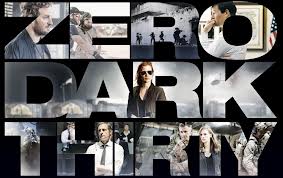
I am afraid of everything but surprised by very little.  I was however taken aback by the recent controversy surrounding Zero Dark Thirty.   The arguments against the film strike me as disingenuous at best.  There are two primary narratives that have been concocted about the film.   The first, is that the movie somehow condones torture.  The second, is that the movie somehow makes the case that torture was a if not the primary contributing factor in finding Osama Bin Laden.
zdt

The first  assumes that the absence of argument against the use of torture is equal to condoning it.  This however does not leave room for the possibility that the absence of argument might just be the absence of argument.  I have doubts that there were many CIA operatives during this time (or ever for that matter) that went around moralizing to their superiors.  That’s something typically left up to politicians who have much less at stake than the agents and analysts in the field.  But let’s forget realism or lack thereof and let’s stick to the writing and filmmaking here employed by Boal and Bigelow.

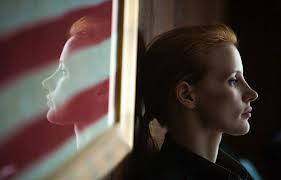
There is nothing in this film that suggests that either Maya or Dan take the torture that they participate in for granted.  In fact, the opposite is true.  Maya never looks comfortable in the room and Dan would rather put up with the politics of Washington than remain where he is.  They are both acutely aware that they see too much, do too much, and this understanding is central to the film.  Maya’s entire arc is built upon the notion that she will lose herself in the process of finding Bin Laden.  That is her journey. And there are stakes. Bombs go off in different parts of the world, people die, because Maya and Dan are failing at their jobs.  That sentiment is palpable on every one of the characters.

I for one am glad that  Bigelow and Boal did not give in to any instinct to moralize or to make the issues surrounding the torture program black and white.  I’m glad that they didn’t tell me what to think and allowed for the shades of grey to exist.  I believe that the people who are offended by this film are more uncomfortable by the grayness of it all than by the torture itself and in allowing us to come face to face with that, Bigelow and Boal knock it out of the ballpark.

The second argument is that torture was a major contributing factor in finding Osama Bin Laden and that somehow this is factually incorrect. This is also dishonest.  First, because it assumes that we have been living under a rock for the last decade.  That somehow we have not lived through the collective trauma of Abu Ghraib, Guantanamo, extraordinary rendition, and Rumsfeld. The folks perpetuating this argument mean for us to believe that at no point in the last decade no agent asked a detainee or victim of torture any questions regarding the whereabouts of Bin Laden, and that none of those questions (that never happened) ever resulted in any actionable intel.  Call me a cynic, but I don’t buy it.  Worse still, the folks who are making this argument also want us to believe that the film happens in a vacuum where there is no time. In fact, many years pass between the moment when Maya hears about the courier and the moment when the intelligence is acted upon. Throughout that time the lead was dropped completely and later revived. More importantly, the case the film actually makes is that only a few people believed that this was  a lead at all and that Maya had to build a case and convince others in painstakingly detailed ways.

“Bin Laden wasn’t defeated by superheroes zooming down from the sky; he was defeated by ordinary Americans who fought bravely even as they sometimes crossed moral lines, who labored greatly and intently, who gave all of themselves in both victory and defeat, in life and in death, for the defense of this nation.” Kathryn Bigelow – LA Times 1/15/13

On the other side of the coin, defenders of the film have said that “hey, it’s just a movie”  so everyone should relax. But I refuse to see things this simply.  It is just a movie, sure. Its purpose is to entertain not educate, sure.  But that doesn’t mean that a film cannot do both.  This is in essence what I find the most surprising about the arguments surrounding Zero Dark Thirty — I found the film to be more interesting than it was dramatic.

There is a misconception about how movies communicate, particularly movies grounded in fact or research.  Filmmakers do not have unlimited words with which to work. We must make our case as efficiently as possible and get you out of the theater before you walk out.  The only way to do that is to strike at the essence of subject rather than the facts of subject.  Think of your favorite biopics.  If you leave those films understanding the type of man/woman the subject is, then you have been educated and informed regardless of how the facts have been fudged with to create drama and entertain.  Raging Bull, Amadeus,  Lawrence of Arabia etc. all come to mind.  This is the lesson of Citizen Kane. What is at the heart of the subject? Rosebud.  If you write that, then you achieve the truth regardless of the facts. It is called fiction after all.

The discussion surrounding Zero Dark Thirty ignores everything that happens outside the torture chambers.  The great wealth of characters it took to find Bin Laden.  The determination and sacrifice involved. In fact, the film is most effective when it mires itself down in the details of the investigation. When we see the spycraft and all of a sudden we are confronted by just how impossible the task of finding Bin Laden is.  There are two needle in a haystack sequences in particular that are filled with dramatic tension and are both deeply entertaining and informative. They have characters trying to find one person in a population of millions and informants tracking a single car through a winding city.  These moments are as crucial to the finding of Osama Bin Laden as the torture is.  The mission required a lot of different forms of intelligence gathering and many  individuals. That is the essence of the mission and the truth we are supposed to walk away with.  So it surprises me that people were simply not watching the same movie that I was.
zdt2

And it is not a perfect movie by any means.  It is not the best picture of the year and I do not believe that Bigelow’s snub from the Oscars is all that controversial or undeserved.  The film fails miserably at allowing us to feel anything.  We are never given a moment in which to latch onto Maya or come to some understanding of what she has lost or gained in the process of this hunt. She says  “A lot of my friends have died trying to do this. I believe I was spared so I could finish the job.”  But we are never allowed to feel this with her or to experience her loss, how it pushes her, or why it matters.  Her closest relationships are  leaped into without development.  It makes the movie feel distant, detached, and cold.  There is nothing true about how these characters act towards each other and that is what I find unbelievable.  Of course we cannot have it all.  The task these filmmakers undertook was monumental.  This is a huge story with a lot of terrain to cover and character was sacrificed in order to offer us as complete a picture as possible in two and a half hours.  But it’s success in doing so hinges on what you consider complete.

Memorable Shorts from 2012 – Long Branch

Quite possibly my favorite from 2012.  A perfect example of simplicity and cleverness.  A must see.

BSG: Blood and Chrome

Battlestar Galactica, the re-imagined series, is by my estimation one of the best written series to ever grace the small screen.  From the very first episode it aimed high both stylistically and thematically.  It was unafraid to delve deeply into the cultural and spiritual questions plaguing a post 9/11 America and addressed the weight of war to a society thrust into conflict.  It was wicked smart and it was this intelligence that endeared it to critics and audiences alike.

On the ratings side however, it was a roller coaster.  As Dave Howe, president of the Sci-Fi (SyFy) channel, put it “Battlestar was a spectacular flagship show for us – the level of critical acclaim around that show was pretty unprecedented for any cable network.  But ultimately, it didn’t bring in as many viewers as it had the potential to because it was on a network called Sci-Fi and it was set in space.”   To further complicate things, the show came with the heavy price tag of almost  $1 Million per episode during its first season.  This is the legacy of BSG: a show with critical acclaim, mediocre ratings, and high costs hard to justify to a television industry averse to risk taking and stuck in the ice age of Nielsen audience measurement.

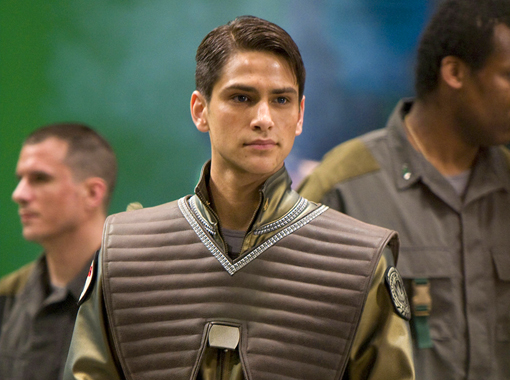
bcWhich brings us to Battlestar Galactica Blood and Chrome, the second prequel to the BSG universe and a show frustrated by its predecessor’s legacy.  B&C follows William Adama as he leaves flight academy and joins the fleet.  He walks into combat as a cocky almost untamable young man.  In the two hours here presented, on the Machinima Youtube channel and in February on SyFy, Adama learns that all is not what it seems and ideals can quickly be used against you or exploited as a weakness.

Adama joins the ranks of Galactica as its newest hotshot pilot.  He expects that glowing recommendations will lead to complicated combat misisons, but instead he is given a “milk bc3run”  to deliver cargo.  He and his co-pilot, Coker, are surprised that the cargo is actually a person, Dr. Becca Lee, and the mission is not as simple as initially described.  Adama and company must deliver Dr. Lee to a moon deep in Cylon controlled space where she is to conduct activities that will deal a huge blow to the Cylons.  I will not spoil the plot details here, but I will say that in BSG fashion  the surprises keep coming.

Thematically, it doesn’t strive for the depth of BSG’s pilot or even Caprica’s.  Nor does it try to present a complicated web of characters.  It has a simple through line and delivers high-octane action. It also gives us a glimpse of what it could have been had this been picked up by the network as a series.  Adama’s relationship with his father, presented here through a voice over, only scratches the surface. But it points decisively at a potential exploration of Adama’s perceptions of war and peace.  This young man, Adama, walks into battle with a list of heroes he wishes to emulate and a set of expectations about what he will accomplish. These are slowly torn down throughout the episode Bc2and at the end Adama is presented with some unadulterated truths about heroism and war.  Galactica’s admiral says to him “Truth is the people support this war with their money and they will stop if we stop giving them hope. So let them have their heroes, let them have their unblemished victories, while you and I fight the real war.” 

I do not believe that Adama fully buys into it, but he realizes that the road ahead will be full of difficult choices that blur the line between good and evil, hero and coward and that he will have to define himself somewhere in that muck.  Unfortunately for us, it is a road we will not get to see despite the obvious potential the storyline and this franchise present.

Blood and Chrome on Machinima, it will air in full on SyFy

Episode 1

Episode 2

Episode 3 & 4 

Episode 5 & 6 

Episode 7 & 8

Finale

How To Survive A Plague

The movie that I was the most excited for last year was a documentary by David France called How To Survive a Plague.  The film follows ACT UP during the early days of the AIDS crisis.  Maybe someday I’ll write my thoughts on the film. For now however I just wanted to celebrate its Oscar nomination in the Best Documentary category.  There are very few films that I would deem ‘important’  this is one of those.  Go see it if you haven’t.

http://surviveaplague.com/

hsap

Below is an interview with David France from PBS Newshour

http://video.pbs.org/video/2311582066&#8243

Memorable Shorts from 2012 – The Piano Tuner

The Piano Tuner directed by Olivier Trenier is quite older than 2012 but I was only able to see it last year.   It is a lesson in getting to the point and getting out before the audience can start asking too many questions. This short film tells the story of a failed musician so desperate for sympathy that he pretends to be blind as he makes a living as a piano tuner. The film is all set up, but the premise is intriguing and the character and actor are charming. It’s easy to see the humor and desperation in what he’s doing. Then, about 8 minutes into this story something quite delightful happens … the story becomes a thriller. 

This is solid work all around, just remember not to ask too many questions.

Script of the Week: Rodham by Young Il Kim

The story of a young Hillary Rodham as she struggles to choose between a career as a hot-shot Washington lawyer and the love of her life, an indomitable Bill Clinton. The script by Il Young Kim (nom de plume?) focuses on Hillary as she works in the committee to impeach Richard Nixon and weighs a marriage proposal from Bill.

Young-Bill-Hillary-bill-clinton-9773733-531-411The writer handles the subject matter delicately and cinematically.  This is not a bio-pic in any sense.  Kim aims for the essence of Hillary rather than a portrayal of historical truth.  It allows him to delve deeply into the character’s emotional life and present us with a Hillary that is saucy, sexy, full of urges and contradictions.  She is Hillary as we have not seen her before or at least not thought about before.  The Bill we get is equally interesting but for inherently different reasons.  He is exactly how we imagine him to have been.  He loves Hillary madly but just can’t help being himself … totally and completely wrong for her.  This dynamic keeps the script fun and makes it a compelling read even making us wonder (if only temporarily) if they’ll end up together.

We are informed by history of course.  As I read this script there are moments so shock full of irony you can’t help but point them out and go “ha!”. A young Jim McDougal talking about waterfront property;  A Bill that flirts with anything with two legs and a skirt;  A young Hillary that believes a woman will be President before a black man;  The countless characters who all know Hillary is going to be that woman; And most importantly the young ambitious lawyer who helps define an impeachment process that would decades later be used against her husband.  History also informs how we cheer for Hillary, her eventual happiness is always in our sights.  With so much information about her tumultuous marriage I couldn’t help but hope she would dump Bill and end up with the dashing Weld.  I knew how the story would end of course, but my hoping is a trick the writer deserves immense credit for.

If there are any faults with Rodham is that Kim has chosen a period of time so compelling in its own right that it sometimes outshines the character’s story.  Hillary’s time on the House Judiciary Committee that investigated Nixon is replete with intrigue and interesting characters, many of whom are still players in the current political stage. As a political junkie I ate it up and even found myself wishing that the story was solely focused on her work during that time. Alas, as we all know, for the Clintons work and self are never far apart and so it is with this script. At the end I do not know how accurate or well researched the script is, but I know it made me go running for the internet yearning to learn more.  Any script that does that is good in my book.

A Chat With David O. Rusell – NY Times


Memorable Shorts from 2012 – The Beauty Inside

This is a webseries and a compelling piece of branded media. The concept is simple — Alex wakes up as a different person every day. Physically different that is, inside he is always the same. The story is narrated by the real Alex as he ventures to find love and himself despite his unusual condition.

The film/series is also a “social film”  and a creative use of new media for the digital age.   Professional and student film makers are always asking the question, “how do I build an audience?”.  The Beauty Inside answers that question rather innovatively: put the audience in the movie. 

Check out the short behind the scenes look below:

As a piece of literature


“I don’t write a blueprint. I want the script to work as a piece of literature” – Tarantino on scriptwriting


Post Navigation