Sometimes a Good Notion

Archive for the category “Film”

The Amazing-ly Frivolous Iron Man 3

posterIron Man 3, with it’s superb cast,  A+ effects, and non-stop action is thoroughly entertaining fare and a perfect summer opener.  It is also downright disappointing.  Director/Writer Shane Black misses the mark set by his predecessor. He creates a film devoid of irony or tragedy. This Tony Stark is more concerned with getting to his next one liner than he is with the more existential threats that surround him. This cavalier attitude towards adding any gravity to this film is reflected in the cheap plot twists that waste the talents of actors like Kingsley and Pearce and insult the audience’s intelligence.

The film opens with a flashback to a party where a desperate Aldrich Killian (Pearce) pitches his scientific organization to Stark and Dr. Maya Hansen (Rebecca Hall).  Stark,  more interested in bedding Hansen than developing business relationships, asks Killian to wait for him on the roof on that cold New Years Eve night.  Needless to say, Stark never shows, and we are left with the image of Killian waiting alone and as desperate as we first saw him.  We exit the flashback with Stark explaining that on that night he created demons that would forever change his life.  It’s a ridiculous notion… and makes the rest of the story inconsequential. Writer/Director Shane Black would have us believe that Killian would go on to become a criminal mastermind and terrorize the world  because he was well, for lack of better words, stood up. He could have just made an appointment. Check your brain at the door kids, it doesn’t get any better from there.

Where Iron Man 3 excels is at providing the non-stop action we have come to expect in summer films. The set pieces pepperrun into each other beautifully and the action is almost ceaseless. It is anchored by Downey Jr.  who is as good as he has ever been, and  Paltrow who gets well deserved screen time and is the foundation around which the drama revolves. The story also uses a different mechanic to move the plot along.  It is closer to a detective story than its predecessors. Stark spends most of his time outside of his iron suit, depending only on his wit for invention and sarcasm to get closer to the truth.

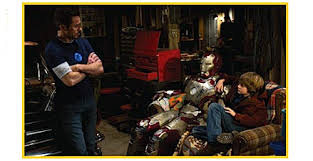
The best moments in the film come from the budding relationship between Stark and Harley Keener (Ty Simpkins), a kid Stark befriends as he investigates the mysterious bombings occurring around the world. These two play off each other naturally, and the comedy here is a well deserved reprieve kidfrom the explosions, violence, and plot.

Iron Man 3 is a good flick.  It entertains as it should but it comes nowhere near adding anything valuable to the franchise. We have come to expect some darkness in our heroes.  The costumes they wear should be more than just razzle and dazzle.  They should be a curse to the character and a blessing to society. Favreau, the director of films 1 & 2, understood this enough to at least nod to it. Stark’s existence, physical and metaphorical, was tied to his father’s legacy.  His monsters, Obadiah and Vanko, where not his own.  They were his father’s. There was irony in this.  All of that is gone in Iron Man 3. The only thing we learn is that Tony Stark is a bully  and that Shane Black likes jokes… lots and lots of jokes.

New & Notable: Voice Over

At the end all I could say is, “This is beautiful.”    I often tell my students not to confuse conflict with action.  We are so used to explosions every so many minutes we forget that there is drama and tension in the simplest of moments.   Voice Over, directed by Martin Rosete, does wonders with the notion that life is full of extraordinarily dramatic moments.  This is clever and beautifully produced.

New & Notable: April

Directed by: Alan Spearman

001_April_mThe photography here is quite good and the director moves through the narrative at a brisk pace.  It’s a beautiful study contrasting the secrets we keep as children and the ones we keep as adults.  The child understands that it is scared, the adult understands why.  Despite the substantial differences, the director allows for both of his characters to speak of their understanding whimsically which adds depth and substance to the barely audible words.  An official selection of Slamdance 2013.

Memorable Short from 2012: Foolishly Seeking True Love

Directed by: Jarrett Lee Conaway

fstl

To be honest I don’t remember when I first saw this.  It was most likely 2011 but oh well.  This is a great combination of sleek storytelling and style.  From the opening shot, as we slowly move back from our hero and through the tambourine, you know that you are about to see something special.  It has an air of fantasy, fairy tale, and foolishness which is never overplayed.  The filmmakers don’t go for the joke but rather allow the moments to play out naturally and treat the wistful improbability of the situation earnestly. It’s really quite funny and sweet and just the thing for the pre-valentines day blues.


New & Notable: Bear

bearA small tribute to Jack, played by Director Nash Edgerton,   a memorable young man who deserved his very own sequel.   In order… Spider and Bear

New & Notable: Dog Eat Dog

pet Petsami presents Dog Eat Dog directed by Sian Heder.  This is a very clever and funny little story with great execution and pacing.  Thoroughly entertaining from beginning to end.

Be simple, be witty.

New & Notable: C 299,792 Km/s


c1With Star Wars being handed to JJ Abrams, Science Fiction moves forward into the new century with huge fanfare.  In this environment the arrival of C 299,792 Kilometers Per Second, which harkens back to the days when filmmakers actually built things, feels quite refreshing.

The story is nothing new and the script could have used a few more drafts.  Many more drafts…  Most of the lines are undeliverable and the set ups feel awkward.  The relationships are underdeveloped, the acting is stiff, and the situations forced. No amount of retro can save this film from its story.   However, the work directors Derek Van Gorder and Otto Stockmeier do here in creating the visuals is outstanding. 

The film will make waves on the internet because it is strangely innovative.   The filmmakers describe the creative process as follows:

To build the future, we looked to the past. No CGI or greenscreen was used in the making of the film; all our sets and c2props were built by hand and filmed in-camera. Combining new advances in digital camera technology with traditional special effects, we sought to create a unique, timeless look through lighting design, camera tricks, miniature photography, split-screen, and stop-animation. We believe that this approach allowed us greater creative possibilities on a low-budget science-fiction film.

The world they have created looks and feels tangible and is reminiscent of early science fiction films. It is also beautiful.  They have taken advantage of digital technology to create exquisitely sharp and realistic images and they have paid great attention to basic cinematic techniques that further help create the world.  Cinematography and sound c3design are at their best here. There isn’t a frame that fails to use lighting and hue to create mood or a second where the humming of machinery doesn’t influence the work  in the same way. Technique enhances the sense of here and now and never feels over done or pompous. If they had paid as much attention to the script then C 299,792 Kilometers Per Second could have been much more than an aesthetic piece.

Intriguing as well, is that the narrative is intercut with a film within a film.  A documentary, titled Beyond the Infinite,  Printtracks human progress and provides us with the reasons  humanity must take to space.   Beyond the Infinite, also has its own retro feel which is used to enhance the aesthetic feel of the film.  Shot in 16MM, its first frames throw us back to 70’s New Age science fiction documentaries and serve as a reminder of a golden age of a genre that we seem to be quickly leaving behind.

McKee Says

I open up Robert McKee’s Story to a random page and write about what I find.

McKee says:

Storytelling is the creative demonstration of a truth. A story is the living proof of an idea, the conversion of idea into action.  A story’s event structure is the means by which you first express, then prove your idea… without explanation.  Master storytellers never explain.  

Story_Page_08h-150x150What I love about McKee is that sprinkled through the 400 pages of Story are these nuggets of pure truth that every writer should take to heart.  It is by no means original, Seger and Field say the same thing, but nobody does it with the same dramatic flair as McKee.

I have been carrying Story around with me for the last couple of weeks just waiting for an opportunity to open it.  I was delighted that this was the random selection this go-around because it is typically one of the very first things I explain to students who are just beginning their journey as screenwriters or filmmakers.

We all commit the crime of falling in love with an idea.  Many times we also try hard to write the idea, or pitch the idea when in fact we should be trying to write or pitch the story — the action.  When a student begins to talk about their screenplay by saying “my story is about”   I stop them and remind them that their job is to communicate action.  Tell me what happens in the story, not what it’s about. To exemplify why they should do this I show them the scene from Sideways when Miles explains his novel.   It goes like this:

                                     MAYA
                         So what's your novel about?

                                     MILES
                         Well, it's a little difficult to 
                         summarize. It begins as a first-person 
                         account of a guy taking care of his 
                         father after a stroke. Kind of based 
                         on personal experience, but only 
                         loosely.

                                     MAYA
                         What's the title?

                                     MILES
                         "The Day After Yesterday."

                                     MAYA
                         Oh. You mean... today?

                                     MILES
                         Um... yeah but it's more...

                                     MAYA
                         So is it kind of about death and 
                         mortality, or...?

                                     MILES
                         Mrnmm, yeah... but not really. It 
                         shifts around a lot. Like you also 
                         start to see everything from the 
                         point of view of the father. And 
                         some other stuff happens, some 
                         parallel narrative, and then it 
                         evolves -- or devolves -- into a 
                         kind of a Robbe-Grillet mystery -- 
                         you know, with no real resolution.

                                     MAYA
                         Wow. Anyway, I think it's amazing 
                         you're getting it published. Really. 
                         I know how hard it is. Just to write 
                         it even.

                                     MILES
                              (squeezing it out)
                         Yeah. Thanks.


After saying all of this, he has said nothing at all. It’s what typically happens when the writer believes it is the idea that communicates. In truth, it is the other way around. Like McKee says, story is the conversion of an idea into action. It is the summation of all events, from Inciting Incident to Resolution, which allows you to communicate the idea.

The act of understanding comes from the interpretation of action.  What did the character do? How did he relate? What was the result? It is the answers to these questions that allow the viewer to understand what the movie is about. Without action there is no meaning … there is no art. Without action there is no idea, just the ramblings of a writer who doesn’t know what he/she just wrote.

Film Festival Basics: Where and How to Submit

A terrific rundown by Riley Hooper over at VIMEO    Click Me


If you’ve considered the objectives and feel that it’s the right time and you’ve got the right film, then it’s time to get submitting! In this installment of Video School’s foray into film festivals we’ll consider the following equally-Earth-shattering questions: Where should I submit? and How?

First of all, a great resource to use is Withoutabox. This handy web site represents more than 5,000 festivals all over the world. From finding the festival, to filling out submission form information, to paying the submission fee, to submitting your screeners, the entire submission process for most film festivals happens right there.

Finding the right festival(s)

With thousands of festivals out there, it can be daunting to narrow it down. Think about your film and your audience. You may not be ready for this level of festival yet, but to put things into perspective, Cannes is brimming with prestige, with lots of world premieres and European art-house films. Sundance is more focused on the indie scene and discovering fresh talent. TheToronto International Film Festival is known for Hollywood distribution deals and well-established filmmakers. The Venice Film Festival is the oldest international film festival in the world and draws a lot of high-profile European films, and, as it goes hand in hand with theVenice Biennale art exhibition, film and video art. These festivals, aside from Sundance, aren’t particularly good for short films. There are, however, shorts-only festivals. Noteworthy shorts fests include Aspen Shortsfest, the Palm Springs International Shortsfest, and the Cleremont-Ferrand Inernational Short Film Festival. If you’ve created a short that you think is Oscar-worthy, make sure you submit to an Oscar contending festival. There are documentary-specific festivals, such as SilverdocsHot DocsTrue/False and IDFA. Good festivals for animation include the Annecy International Animation Film Festival and the Ottowa International Animation Festival. There are also festivals for just comedies, horror films, and for any subculture or genre of film imaginable — LGBT, the environment, etc.

To get an idea of whether or not a festival is right for you, take a look at the lineup from the previous year. If the films are similar to yours in terms of content and quality, that’s a great sign!

The rules and guidelines of the festivals themselves will inevitably inform your decision process. Be sure to read over them carefully before you submit. Some festivals require your film be a certain length, or others require that your film be a premiere.

If you’re on a tight budget, another factor to consider is submission fees. Most festivals require a submission fee to cover the cost of backend logistics. In some cases you can request, and may be granted, a fee waiver, but in most cases you can count on spending between $20-$80 (usually around $25-40) to submit your film.

Submission forms, press kits, and screeners

Once you’ve finalized your list, it’s time to submit! Most festivals ask for the same type of information in their applications. You’ll need to write various lengths of summaries — a short, long, and perhaps medium synopsis, as well as a log line: the all-important one sentence summary slash attention-grabber to hook your audience. Here’s an example logline written by our very own Mark:

“On a quest to fight robot dinosaurs and save the world from the Butterfly King, John is plagued by a rare disease that slowly turns him into a hot pretzel.”

You may wish to include a press kit with your submission. Press kits can vary in terms of form and content, but they essentially provide background information on your film for members of the press for promotional purposes. It can include an in-depth synopsis, cast and crew bios, interesting anecdotes or a Q&A with the director, reviews of the film, and production stills. Create a nicely formatted PDF document of this information and viola! you’ve got a press kit. You may also want to include screenplays, trailers, promotional clips, posters, photos, and logos via your press kit or Withoutabox. A snazzy website can cover a lot of ground on this front as well.

Once you’ve submitted all this information, you’ll need to send off your film! They call these screeners. Most often film festivals will ask for DVDs. Make sure you format them correctly and mark them with the appropriate information requested by the festival. Some festivals, but not all, now accept links to online versions of your film, so you can send them a password protected Vimeo link, or an IMDb secure online screener.

Your screener is then shipped off to a remote ice fishing hut in Siberia where a man named Igor uses them as insulation for his home. Just kidding! They are sent to people called festival programmers, who spend hours, days, and months watching each and every film and choosing the final lineup.

Sharing your film online

But of course, as a Community Manager of a super swell online video hosting platform, it would be most inexpedient of me to leave this meditation bereft of mention of online marketing and distribution! A lot can be said for sharing your video with the online community. In fact, a lot is said in this recent Video School lesson by guest professor Andrew Allen from Short of the Week. In it, he compares how his film was received in festivals versus online. I highly recommend reading it!

This is an exciting time for filmmaking. The internet has completely revolutionized the way we watch and share media, and it isn’t done yet! Online platforms increasingly contribute to all five goals I have mentioned. Gaining exposure, networking, distributing, winning awards, and having the experience of sharing your work with others are certainly all things that have happened through releasing a video online. Not to mention, new online monetizing systems, such as… ahem… Pay-to-view and Tip Jar, offered by Vimeo Creator Services, are circumventing traditional distribution models, putting the control in the hands of the creator.

In the end, in most cases festivals and online distribution are not mutually exclusive. A good film can, and often does, have a successful festival run followed by, or in conjunction with, a viral online campaign. In fact, five of the six Sundance-selected short films currently online are hosted on Vimeo! Just make sure you get the most out of festivals before you release the film online, as some festivals (but not all!) don’t accept a film if it’s premiered online. Whether you go the festival route, the online route, or both, really depends upon your film and your position in your filmmaking career.

If you ask me, in the end your film should end up right here, on Vimeo! I promise our online community will greet it with open arms — with Likes, comments full of praise and constructive criticism, unicorn kisses, and virtual hugs.

Script of the Week: Story of Your Life by Eric Heisserer

It’s the type of story that leaves you questioning the material for hours after you read as you try to decipher the pieces of the puzzle presented on the page. It has been the most surprising read of the year so far. From its synopsis on the Black List:

soyl

Based on the short story by Ted Chiang. When alien crafts land around the world, a linguistics expert is recruited by the military to determine whether they come in peace or are a threat. As she learns to communicate with the aliens, she begins experiencing vivid flashbacks that become the key to unlocking the greater mystery about the true purpose of their visit.

I expected typical Science Fiction fare, but this is so much more. It is the stuff that great Science Fiction is made of. It reflects on our humanity in the context of an Alien Invasion and presents a profound understanding of who we are and where we are headed. It is also impossible to describe without major spoilers. The plot line is too intertwined with the ending twist and I would be doing the film a disservice to explain it.

What I will say is that this script presents a human race with serious choices to make about how we live and relate to each other. It argues however that there is hope for us still and that the future is ahead of us and perhaps even above us.

Post Navigation