Sometimes a Good Notion

Archive for the month “November, 2011”

Things You Didn’t Know About Me: Ten Favorite Books Edition
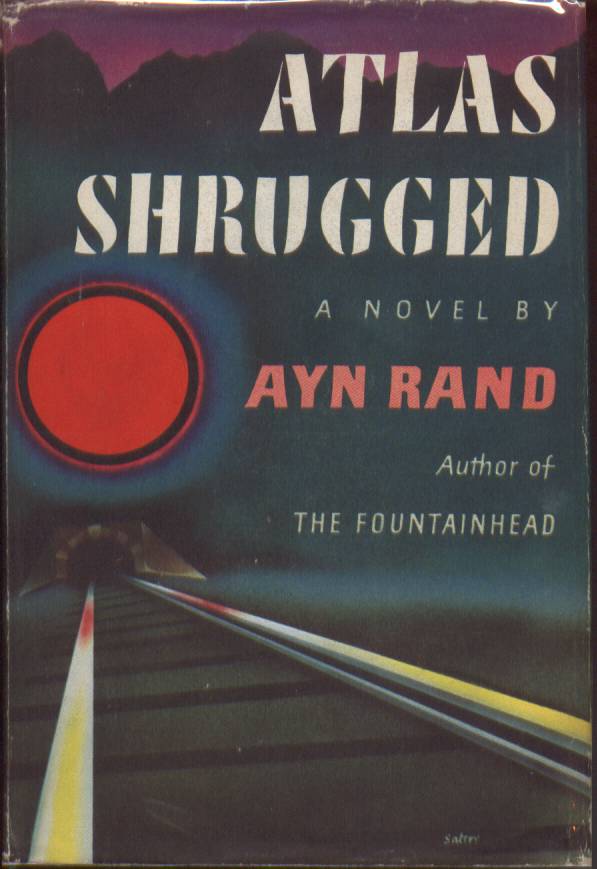
Atlas Shrugged –  Ayn Rand : Everyone always told me to read it and in Grad school I found the time to pick up this massive book. I don’t particularly care for the politics and find the logic of Rand’s argument flawed, but the action in this book is exquisite.  The pace is incredibly well timed and it’s a surprising page turner once you get past the repetitious hoo-hah.  It is my lifelong dream to adapt this into a film, and I mean a proper one, with stars and a real budget.

Harry Potter: The Half Blood Prince – J.K. Rowling : My favorite in the series even if someone told me the ending before I had read it.

A Most Wanted Man – John Le Carre:  I’ve read a lot of Le Carre, more of him than any other author,  but there was timeliness to this one that I hadn’t felt before.  It takes place in Hamburg post 9/11 where the CIA, MI6, and the BND have converged around a disillusioned Muslim named Issa.  Le Carre writes smart espionage driven by character and he builds tension by pitting idealism against the practicalities of espionage and mission.  Extraordinary rendition is at the heart of the novel’s tension, and the questions Le Carre poses are worth considering.

Digital Fortress – Dan Brown:  Though not as juicy as say The Davinci Code,  Digital Fortress is non-stop fun.  It’s my favorite Dan Brown book to date.

Cronica de Una Muerte Anunciada – Gabriel Garcia Marquez:  This is a terribly convoluted and wonderful crime story. The idea that the everyone knew that Santiago Nasar was going to be murdered has stuck with me the majority of my life.

Our Man in Havana –  Graham Greene: For me, if it’s not Le Carre it’s Greene. His bumbling fools turned spies are fun and relatable.  His canon has a lot of great books, this is my favorite primarily because of location.

The Great Gatsby – F. Scott Fitzgerald: I just really wanted to go to the parties!
 The Catcher in the Rye – J.D. Salinger: Who doesn’t feel like Holden sometimes?

Beloved – Toni Morrison: This book needs to be read primarily for the brilliance of its structure.

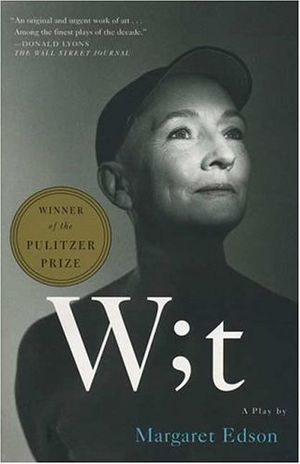
W;t – Margaret Edson: It follows poetry professor Vivian’s last hours of life as she dies from cancer in a hospital. It’s touching, intelligent, and full of humor despite the subject matter.  The contrasts make it rich and wonderful. It can be enjoyed as a play or as an HBO movie starring the terrific Emma Thompson.
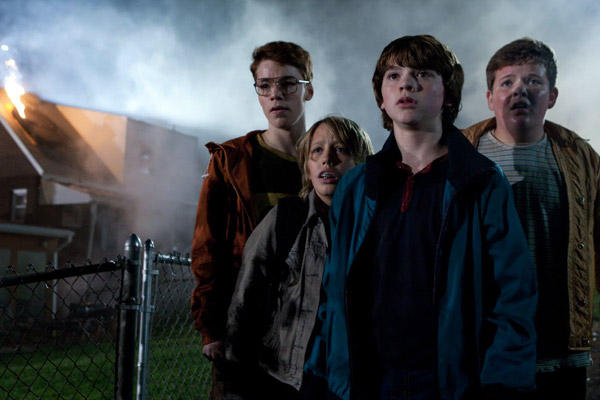
Super 8

JJ Abrams pays homage to Spielberg in this fantastically entertaining adventure.

Abrams knows pop-culture and has been providing sleek entertainments for over a   decade.   With each (Star Trek, Alias, Lost) Abrams has supplied us with stories filled with cool and just enough depth to keep us interested.  He is not however an innovator. His most successful works on screen thus far have been retreads of old stories and old themes we’ve seen before but Abrams manages to infuse each with so much youthful imagination that they are unexpectedly fun.

Super 8 falls squarely into this description.   The story is straight out of Spielberg’s canon.  At the crux of it is young Joe Lamb (Joel Courtney) who is coping with the death of his mother and a father (Kyle Chandler) who doesn’t quite understand him.  He finds solace in a group of rambunctiously nerdy friends who are in the middle of filming an 8mm Zombie flick for a local competition.  Mostly through happenstance the friends find themselves embroiled in a conspiracy to cover up the existence of a man-eating alien and must confront the being itself.   Through all of the action, explosions, mayhem, and clever escapes,  Abrams’ camera never loses sight of Joe who discovers that life is full of pain and loss and though even as it is important to remember he must also not forget to live on.  The screenplay is classically structured with beautifully executed act breaks and an elegant resolution. Abrams is not subtle in telling his story but manages to get such fine performances that one can’t help but forget that you knew exactly what was coming.

There are some other players that also deserve some mention.  Production Designer Martin Whist has built a terrifically complete 1979.  There is an uncanny attention to detail unusual for a movie where you’re going to blow the set up.  Whist and Abrams remember this period fondly and the art department here contributes greatly to the general feeling of nostalgia the film is desperately trying to create.  From the wall paper to the carpeting, the design is understated and cues our memories to the period filling the fantasy with images that are very real to us.

It would also be remiss if casting directors April Webster and Alyssa Weisberg were not mentioned.   These ladies, long time collaborators of Abrams, have assembled a cast of young players that is worth noting.  The chemistry between these kids (Joel Courtney, Ryan Lee, Riley Griffiths, & Gabriel Basso) is by far the most entertaining part of the movie.  They play hysterically off each other better than the most seasoned professionals.

In the process of watching these kids the audience makes a few discoveries, the most promising of which is a young Elle Fanning.  Fanning plays Alice, the white trash rebel of this Ohio steel town and the subject of all of the boy’s lust.   Alice’s father (Ron Eldard) was involved in Joe’s mother’s death at the local factory.  It makes for Joe and Alice to have an unusual emotional bond from the moment they first meet.   Fanning plays the character with surprising maturity and intelligence. There is a scene early on in the film where the boys are getting ready to shoot one of the scenes in their Zombie movie.  They have invited Alice to play the female lead but expectations about her performance are low.  The director yells “Action” and form the moment Alice opens her mouth the boys are entranced. Their jaws drop, tears rush to their eyes.  The scene plays well; it’s funny, very funny because that expression of awe and amazement at watching someone who possesses a rare talent is what the audience feels as we watch Fanning on screen.

The comparisons to Spielberg will be plentiful in the press, as they should be.  Spielberg produced Super 8 and his work inspired it. Seeing the Amblin logo at the beginning of the film was as exciting for me as the movie itself. This logo has been absent from the theaters for the majority of the last 2 decades.  I grew up on Amblin Films (E.T., The Goonies, Back to the Future, Gremlins) and Abrams, from the very first frames of Super 8 is trying to create a feeling of nostalgia not only for a period but for a type of storytelling that Spielberg popularized during that period.  In this, Abrams is entirely successful and creates a product that not only reminded me of the movies I love, but also of why I love the movies.

Méliès’ Show

If I’ve learned anything from being a Professor the past few years is that preparing a new class is both hard, tedious work and an absolute adventure.  Typing hundreds of pages of lectures is wearisome and sometimes overwhelming. As I’m planning a new course I sometimes feel that I’ll never be finished but the process is also exhilarating.  Each lecture page has to fall into place within the greater narrative of the class and each class must build towards the thesis of a particular course. I try to find ways to communicate with students that are both interesting and challenging to them and to myself.  I want to engage them intellectually at best and keep them awake at worst.  It is work that is never finished. After every term my lectures are filled with notes and adjustments that must be addressed before the start of the next.  The student’s honesty also helps.  Last term one of my screenwriting students told me that I only bored her twice and she reassured me that this was a very good ratio.
Despite the difficulties it’s a process that’s full of discovery.  With every subject I approach I learn something new.  Take for instance my current encounter with some very early Méliès films that I came across as I researched a Film History class I’m teaching this summer.
Méliès, every self-respecting film student, maker, academic, or buff knows as the director of A Trip to the Moon (1902). It is a staple of Film History courses around the world.  I have taken FH courses three times in my academic career and in each the images of Mélièswhacking moon-men with his umbrella have been ingrained in my mind as “important”.   And they are.  Méliès was an early player in the industry and he explored mise-en-scene, montage, and cinematic time before anyone had a name for those things.  Credit must be given and A Trip to The Moon deserves serious discussion.
However, the man made hundreds of films.  What I feel that’s missing in discussions aboutMéliès is the celebration of the pure unadulterated silliness of his films.  The Méliès shorts are cinematic and full of magic.  They, for the most part, don’t have a story or a plot, but not much did at the time.  They present a man, Méliès, more interested in entertaining others than in being remembered for his cinematic contributions.  These short pictures teach us the most important lesson that Méliès had to offer, which is that this is the business we call “show”.
Here are three of my favories: Un Homme de têtes (1898), L’Impressionniste fin de siècle (1899),  Le Diable noir (1905).  Each of these simply for your entertainment.
Un Homme de têtes (1898)
L’Impressionniste fin de siècle (1899)
Le Diable noir (1905)

Post Navigation